


This is the second piece in a three-part series on the thinking behind Global Life Project. If you missed the first one, it’s here.

You think that if you’re not the one holding it together, it falls apart. So you answer the message before bed, just in case. You take the call at the inconvenient hour so you don’t lose momentum. You keep your calendar open across every time zone because you haven’t built the structure that would let you close it. That isn’t dedication. It’s a business that only moves forward when you’re the one pushing it.
For years I managed clients in New York, London, and Los Angeles, first from Copenhagen, then from Doha, and told myself the pressure was just what it cost to be a serious service provider working globally. It wasn’t. It was a structural problem, and it had nothing to do with the time difference.
The hard part to hear is this. The time zones didn’t create the problem, they exposed it. When your business depends entirely on your presence to function, the pressure starts small. You check messages before bed, just this once. You take a call at an hour that costs you sleep, because saying no feels like letting someone down. That pattern looks like commitment from the outside.

What it builds is a business that only runs while you’re personally holding the wheel, which isn’t a global business. It’s a dependency that happens to operate from a different postcode.
I’ve watched this exact pattern across dozens of businesses, not just mine. A founder confuses being available with being necessary, and builds a company that can’t survive her own absence, whether that absence is a vacation, a sick week, or a move across the world.
What changed for me wasn’t a new app or a productivity hack. It was one decision: stop trying to be available to everyone, and start building something that could keep moving without me as its operational center.
That doesn’t mean disappearing or going unresponsive. It means the business runs on structure, communication rhythms, and decision rules that don’t require me awake and watching to keep functioning.
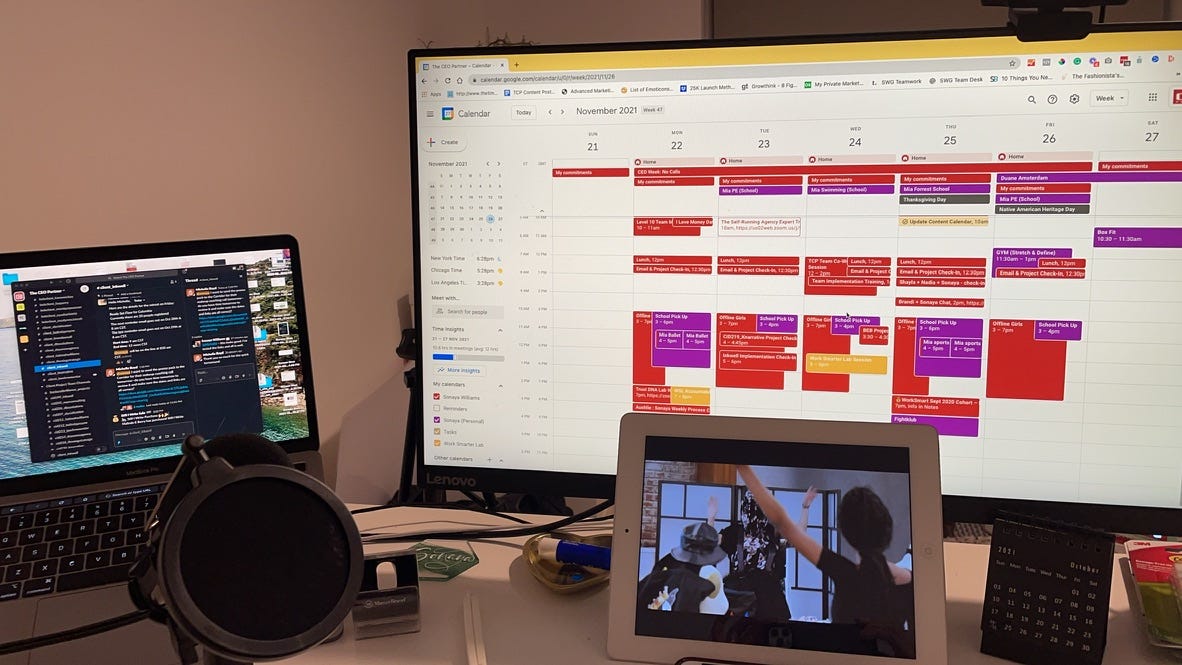
One piece of what that looks like, not the whole build, just enough to show you it’s possible. I work Sunday through Thursday. My clients know exactly which windows are for live calls and which days run on written updates, because I told them once, clearly, as a system, not as a personal preference I’d have to keep defending. A line like I hold live calls on these days, written support runs on the rest, and here’s what happens if something can’t wait does more work in one sentence than a year of apologizing for being in a different time zone.
Boundaries aren’t a personality trait. They’re an operational choice, and when you set them once, clearly, you stop having to re-negotiate them every week. The result for me wasn’t more output. It was the same revenue, with a third fewer hours spent producing it, and the experience of running a global business instead of just existing in another country while running the same exhausting one from a new address.
I’m not going to walk you through the entire system here. That’s the honest line, and I’d rather draw it clearly than pretend otherwise. What matters more than the mechanics is this: the fix was never a personality change. It was a design change, and design changes are learnable.
P.S. Part three of this series is about a decision I made in March, during a war, that had nothing to do with courage and everything to do with a system I’d already built. That’s next.