


I was on a weekly team call with a client last week. She runs a $2.5M consulting firm. Eleven people on the team.
We were thirty minutes in.
I watched what happened.
A team leader brought up a client issue. She gave the context. She offered her details. Then she turned the question to the CEO.
The project coordinator brought up a scheduling conflict. She named the conflict. She offered two options. Then she turned the decision to the CEO.
Another team lead brought up a deliverable that was behind. She explained why. She suggested a path. Then she turned the final decision over to the CEO.

Every person on that call had done the work to think. Every person had a recommendation ready. Each person offered the recommendation and waited.
As the CEO, she answered it all. She was good at it. She has been doing this for years.
After the call, she said something I have heard at least forty times.
“I am the only one thinking about how to grow this business. The only one making decisions.”
I want to tell you what was actually happening on that call.
Her team was not failing her. Her team was doing exactly what she had trained them to do.
She had built a business where the team brings their thinking to her for approval. They are smart. They are capable. They are not stupid about their own work. They have just learned over the years that the final word lives with the CEO. So they prepare their work to bring to her. They do not prepare their work to ship.
That is a different muscle.
A team trained to deliver is a team that decides. They make the call. They write the email. They finish the deliverable. The founder hears about it after.
A team trained to NOT deliver is a team that researches, considers, recommends, and waits. The founder hears about it before.
Her team is the second kind. She trained them to be that way without realizing she was doing it. Every time she overruled a decision they made, she taught them to bring her decisions instead of making them. Every time she rewrote an email they had drafted, she taught them their writing was a draft, and hers was the final. Every time she said “I will handle it,” she taught them that “handling it” was her job.
The team got smarter and faster at preparing things for her. She got busier and more drained from having to prepare and approve everything.
That is the leak.
Brain space is the asset that runs out first when a founder IS the system. It is the cost nobody puts on the balance sheet.
The time you spend approving things your team should have delivered is brain space.
The time you spend rewriting emails is brain space.
The time you spend in your own inbox at 9 pm answering questions that should have been answered without you is brain space.
The time you spend on a team call talking through decisions your team could have made before the meeting started is brain space.
You have a fixed amount of it per week. You cannot grow it. You can only protect it or leak it.
Most CEOs of real businesses leak it all before noon.
Which is why your business has felt stuck for the last twelve months. Why the growth flattened. Why every new idea dies on contact with the day-to-day. You stopped thinking about how to grow it. Not because you got worse. Because you ran out of space.
Last month, I was on a different client call. This was a marketing agency with a team of five members. The founder was telling me about a family trip she had taken.
She showed me her phone.
Slack was full. Not unread messages, she answered all of them. Direct messages from her team. Every one of them was a question. Some of them were urgent. Most of them were not.
“What client should I prioritize on Tuesday morning?”
“Should we send the proposal at the higher price or the lower price?”
“Can I respond to this client this way?”
“Did you want me to use the template or write it fresh?”
She told me she answered them on the plane or at the airport. She answered them in the Uber to the hotel. She answered them while her daughter was eating dinner across from her in a restaurant in another city.
Then she said the line that always tells me what is true:
“Client work pauses when I travel. If I do not answer Slack, things stop.”
That is the same issue as the consulting CEO above. Just on a smaller scale. Five people instead of eleven. The team is trained to bring everything to the CEO. She has built a business that cannot run without her hands on every choice.
She is not the bottleneck because she is bad at delegation. She is the bottleneck because, with the best of intentions, she has taught a five-person team that the answers live in her head.
I have watched this pattern across more than forty businesses. It is the same problem in different costumes. Two-and-a-half-million-dollar consulting firms. Five-person agencies. Solo founders with a VA. Educational businesses. Professional services firms of every size.
The shape is identical. The team is trained to bring. The founder is trained to receive. The brain space leaks.
The conventional wisdom is that the answer is to hire better, train harder, or trust more.
It is not.
You cannot trust your way out of a system you designed. You cannot delegate harder when delegation was never the issue. Better hires do not change the structure. More training does not change the structure.
The structure has to change.
That is the work of The CEO Operating System.
The CEO OS is not a leadership philosophy. It is not a productivity hack. It is the structural redesign of a business that runs on the founder. Three layers, with an AI layer running through all three.
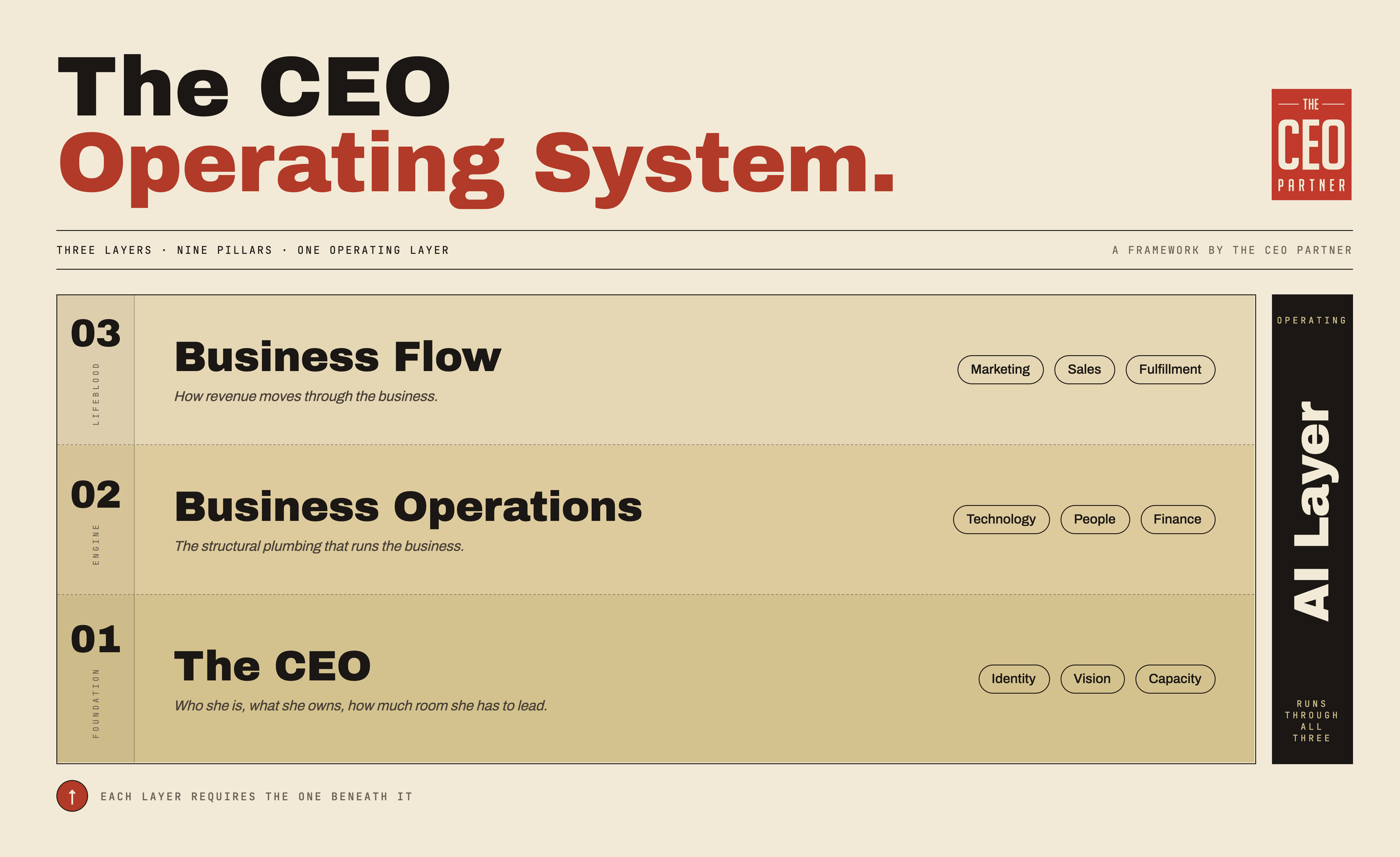
The foundation is The CEO. Identity. Vision. Capacity.
Who she is, what she actually owns, how much room she has to lead.
The engine is Business Operations. Technology. People. Finance.
The structural plumbing that lets the business run without the founder in every seat.
The lifeblood is Business Flow. Marketing. Sales. Fulfillment.
How revenue moves through the business.
Each layer requires the one beneath it. AI runs through all three.
When the system is in place, the team is no longer trained to bring. The decisions get sorted into four buckets before they reach the founder. CEO-only, where her judgment is the asset. Team-owned, where someone else has the authority. Systemized, where a rule replaces the decision. Eliminated, where the activity should not be happening at all. Most founders have one bucket. Their inbox.
The rhythms get designed around the work that actually moves the business. A reactive week is a brain-space-zero week. A designed week protects the thinking time and routes the execution time to the team that owns it.
The roles are drawn in writing rather than by default. The team leader on that call would not have turned the question to her. She would have answered it.
The delivery gets standardized so the quality is in the system, not in the founder’s head. The work goes out the door at the standard the client paid for, without the founder checking it.
Three layers. One redesign. The brain space comes back because the system no longer needs her in every seat.
I want to say something carefully about AI. Because most of what is being sold under that banner right now is wrong.
AI is not the answer to brain space.
Prompts are not the answer. AI tools are not the answer. A library of AI workflows is not the answer.
These things are useful. But they sit on top of an operating system. They are not the operating system.
AI on top of operations you haven’t documented is faster chaos. AI on top of documented operations is leverage.
A founder with no operating system who adopts AI gets a faster version of the same dependency. The team still brings every decision to her. The work still requires her sign-off. The system is still broken. AI just makes the brokenness move faster.
A founder with the operating system in place gets something different. AI becomes leverage. It executes the work the team owns. It supports the decisions that have been sorted into a system. It frees the team to do the work that actually requires judgment. And it frees the founder to do the thinking she was hired to do.
AI is the multiplier on top of an operating system that already works.
It is not a substitute. It is what becomes possible after the structural work is done.
The CEO who installs the system first and layers AI on top is the one who wins the next three years. The CEO who skips the system and uses AI to compensate is the one who burns out faster and more expensively, leaving a team more confused than before.
So here is the question.
How much brain space did you have last week?
Not how busy you were.
Not how productive you felt.
How much time did you spend thinking, actually thinking, with no agenda, no decision pending, no team member waiting, about how to grow your business?
If the answer is zero, or close to it, you are not running a business. You are inside one.
The founder who runs a business has brain space. The founder who is run by one does not.
The work is getting it back. The team has to be untrained. The structure has to be redesigned. And then, only then, the AI can do what AI is good at.
That is the order. There is no shortcut.

A note for the founder running a $2M+ firm
If you are running a $2M+ firm and you read this and recognize yourself, the membership is not what you need.
You need brain space. You need it now.
The CEO Partner project engagement is the work of installing the operating system that gives it back to you. We do this inside your business, with your team. By the end, the team has been untrained. The system has been redesigned. The brain space is yours again.
If that is the conversation you are ready to have, this is where to start.
For the founder who is still building
If you are still building toward the $2M mark, this article is your prevention plan.
Training your team to need you does not start at $2M. It starts the day you hire your first contractor. Most founders only notice the problem when the team reaches 10 or 12, and the brain space is gone. The problems start earlier.
Right now, the work is building the operating system as you grow. Do not retrofit it after the business outgrows you. The Global Life Library publishes one tool every week. The same operator IP I install inside firms paying six thousand a month for it, right-sized for where you are now. Each tool is one piece of the system, built before you need it.
The brain space you are missing is not a personal failure.
It is structural. It is recoverable. And it is the difference between running your business and being run by it.

I’d love to know what you think? Leave a comment below.