


I used to think the spa weekend was the freedom. It was only the exception that proved I hadn’t built freedom anywhere else.
For years, when we lived in Copenhagen, there was a hotel ten minutes from our apartment with an Aire Bath spa. Once a quarter, I booked myself in from Friday to Sunday. No kids, no clients, no calendar. Warm water, my own thoughts, and nothing on the agenda that belonged to anyone but me.
I came home a better wife and a better mom every single time.
For a long time, I thought that weekend was the freedom I’d built my business for.
That weekend was the only place freedom lived in my life at all.
Balance is not a beach with a laptop. If I’m on a beach, I want to be in the water, not answering client emails with my feet in the sand. That was never the dream, and I don’t know a single founder who wants that life once you ask her directly.
Balance looks like picking my girls up from school, getting on a call an hour later, and still making dinner and being there for bedtime. It looks like paying for help at home so the laundry and the floors aren’t one more job I’m quietly failing at. None of that is glamorous.


A specific version of soft life keeps showing up in my feed lately: women who built podcasts, courses, and communities worth real money, announcing they’re stepping back to live softer.
Good for them. They can, because the audience they spent years building will keep listening, and keep buying, whether they publish weekly or once a season.
That’s not proof soft life works. That’s proof a business built on real audience and systems can survive its founder stepping back. It’s their same argument I’m making, just from the opposite direction. If rest had been built into that business from the start, none of them would need to overhaul the whole business model now just to reach a version of balance they already earned years ago.
I know what it looks like to build a business with no balance in it at all, because I did this when I first launched my business.
When we first moved to the UK, I was eight months pregnant, running my agency, and convinced I’d found a real advantage: a five-hour time difference meant I could get a full morning of client work done before anyone in the US was even awake. It felt like leverage.
What it was: a business that needed me awake before dawn, a body about to bring a human into the world, and a version of me who couldn’t yet tell the difference between being resourceful and being unable to stop.
That’s the difference between an advantage and actual balance. An advantage extracts more from you until something forces you to stop.
The real shift didn’t happen at a spa, or from stepping back from work. It happened years later, at my desk, when I rewrote one sentence about how my week worked.
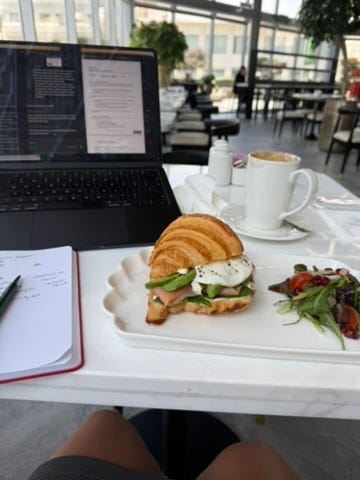
I’d been managing clients across three time zones and answering messages before bed, just in case. I called it the cost of running a global business. The design was the real problem all along, not the time zones. So I changed the sentence: I hold live calls on these days, written support runs on the rest, and here’s what happens if something can’t wait.
Same revenue. A third fewer hours. But it’s the reason I can do the school pickup, the client call, and dinner in the same afternoon without any of it feeling like a magic act.
There’s a distinction I wrote about after we evacuated Doha last year: risk tolerance is emotional, it spikes the second something goes wrong, and risk capacity is structural, built months before you ever need it. Balance works the same way. Feeling balanced for a week is emotional. It spikes after a good stretch and fades by the next crisis. Being balanced is structural. It’s built into how the business runs on the ordinary Tuesdays nobody’s watching.
Soft life sells the feeling. It rarely asks whether the capacity was ever built underneath it.

I’m not arguing for more hustle. I’m arguing against needing to overhaul your entire business just to finally get some rest.
I still book the spa weekend. I still take the two weeks away. But neither one is holding my life together. The pickup, the call, and dinner, that’s what’s actually built in. The rest is just a nice weekend on top of a life that was already working.
If you canceled every soft life ritual you have tomorrow, would anything about how your actual week runs change? If the answer is no, you’ve already built the real thing. If the answer is yes, the ritual has been covering for a system that isn’t built yet.
Freedom was never going to be handed to me for scaling and it isn’t going to be handed to anyone for going soft enough either. Build the rest in from the start, and you never have to renegotiate your whole business just to feel like yourself again.
If this is the tension you’re living in, wanting an actual life abroad and a business that can fund it without swallowing it whole, that’s exactly what the Global Life Library was built for. Inside: the systems, tools, and strategies for designing a business that supports the life you want, instead of one you have to escape from on weekends. It’s part of what Global Founders get access to. If you’d rather build the rest in now than rebuild your whole business later, that’s where to start.