


This is the framework I built because the internet couldn’t tell me what I actually needed to know. Introducing the Global Citizens Framework and why most people approach the global decision completely backwards.
I want to tell you about the day I decided to temporarily evacuate my family from Doha.
It was March 6, 2026, and the war between Israel, the US, and Iran was no longer background noise anymore. It is the kind of news that changes the temperature of a room.
My daughters were picking up on the energy around them, the way children always do, in ways they can’t fully articulate, but as the parent, you can see clearly. The older one stopped sleeping well. The younger one is clingier than usual. My husband and I were watching the news with a different kind of attention. Not the passive scrolling kind, but the kind where you’re actually calculating.
And here’s what I noticed: I wasn’t panicking. We were deciding.
That distinction matters more than it might sound.
We had already done the work. We knew our non-negotiables. We knew our family’s risk tolerance. Not in theory, not as a vague sense of how brave we thought we were, but as a lived, tested, documented understanding of exactly how much uncertainty we could absorb before it stopped being an adventure and started damaging the people I love most. When the moment came, I didn’t have to figure out what we valued. I already knew. My husband made the call, we packed what we needed, and we flew back to London temporarily until the situation stabilizes.
That clarity didn’t come from intuition. It came from a strategic plan.
The problem with how most people approach this decision.
Here is what most people actually do when they start thinking about moving abroad.
They research countries. They join Facebook groups. They watch YouTube videos of people walking through Lisbon, Medellín, or Chiang Mai, with good lighting and a cappuccino in hand. They build spreadsheets comparing the cost of living. They read Reddit threads about visa requirements. They follow the influencer who just left the US six months ago and is now showing you how to do it their way, not your way. They consume enormous amounts of information about where and almost none about should I?
And then they either spend years in a loop of research without ever deciding, or they move on impulse and spend the next two years discovering everything they didn’t think through before they left.
I have seen both. I have worked alongside entrepreneurs for over a decade as their Fractional COO and Strategic Operator. I know what happens when big decisions get made without a strategic plan. The same chaos that hits a business when a founder acts on feeling & emotion instead of structure? It hits a family relocation, too. Just with more passport stamps and a higher emotional cost.
The global decision is not a travel decision. It is not a lifestyle decision. It is a strategic life decision that deserves the same rigor you would bring to any major business move.
Nobody was building that strategic plan. So I built it.
Where I started.
I moved from the US to the UK in 2015. Had my first daughter in 2016. Moved to Copenhagen. Had my second daughter in 2018. Moved back to the UK when my older daughter was struggling to speak either English or Danish. She needed language stability, and I made the call to go back and give it to her, even though it wasn’t the plan. In 2025, we moved to Doha, Qatar, in the Middle East, where we live now.
Four moves. Three countries. Two daughters were born on different continents. One business running through it all.
I also want to be honest about why the US was never going to be a permanent answer for me. I knew long before I had children that I couldn’t raise them there under the conditions that keep getting worse. The rising cost of living that makes a middle-class life feel increasingly out of reach, the lack of work-life balance that is baked into the culture, the daily reality of school shootings, and healthcare costs that punish families for simply existing. These weren’t abstract political opinions. They were practical calculations about the kind of environment I wanted my daughters to grow up in.
And I am an only child. Which means I also carry the sandwich generation reality. Building a life that works for my daughters while remaining present and available for my mother as she gets older. That isn’t a footnote in my global decision. It is a central factor.
Which countries make it possible to get back home quickly when I need to? What does my proximity to my mother actually need to look like for this to be sustainable in the long term?
Those questions belong in the framework, too.
Each move taught me something the previous one hadn’t. But the most important thing I learned was the thing that changed how I approached every subsequent decision: the quality of a global move is determined almost entirely by the decision that preceded it.
Not the visa process. Not the cost of living. Not the weather, the schools, or the tax rate. The decision. How honest it was. How complete it was. Whether the right questions were asked before the tickets were booked.
I was raised by a single mother who worked multiple jobs to keep us going. I started my business in 2011 specifically because I didn’t want to be the parent who was always working and never present. Building a life that was intentionally designed, not just inherited by default, has always been the point. The global piece extends that same intention.
The Global Citizens Framework is what I built to make that intention operational.
What the framework is and what it isn’t.
Let me be direct about something before I explain it.
This framework does not tell you where to move.
I am not in the business of recommending countries. I don’t have a favourite. I don’t have a list of the best places for entrepreneurs, families, or Americans abroad. That information exists everywhere, and most of it is useless to you because it isn’t about you: your life, your business, your family, your specific constraints and requirements, and risk tolerance.
The framework helps you make a clear, honest, structured decision. Whether to move at all. And if yes, the foundation for figuring out where on your terms, based on your actual life.
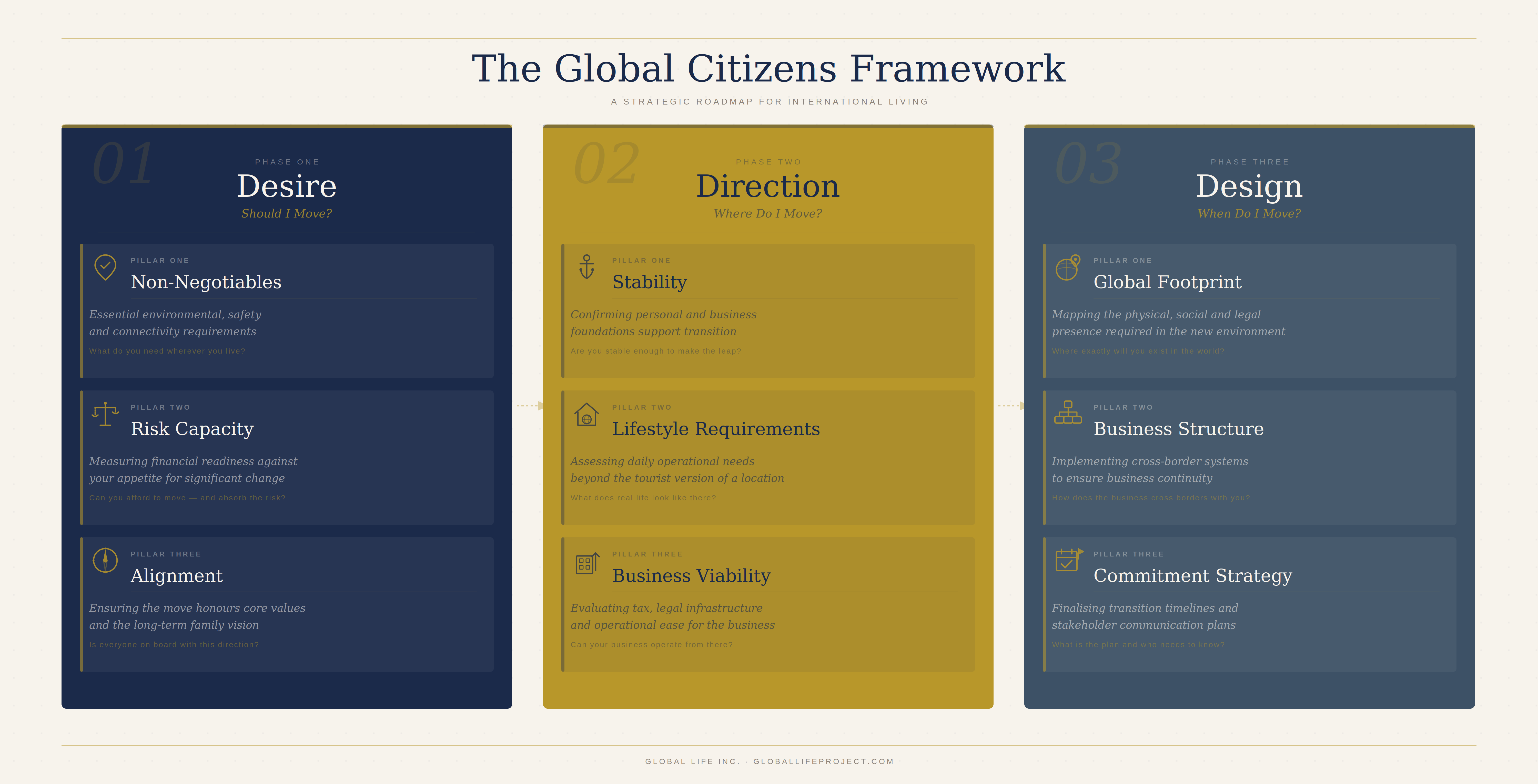
There are three phases. Phase 1 is the one nobody wants to do and the one that determines whether everything else works.
Phase 1 Desire: Should I move?
This is the phase most people skip entirely. Instead, they jump straight to the Instagram influencer’s highlight reel of a new life abroad, or the 6-step checklist that promises to tell you how to move countries as if it were a weekend project. None of that tells you whether the move is right for your life. It just tells you how other people did it their way.
Phase 1 asks three harder, more important questions.
What are your non-negotiables?
These are the things that have to be true about wherever you live, not preferences, not nice-to-haves, but actual requirements that, if unmet, make a location wrong for your life, regardless of how appealing it looks on paper.
Mine include direct flights to the US. Not connecting flights. Direct. I have a business with clients and relationships that require me to be accessible. I have family back home. I am an only child with an aging mother. The distance between us needs to be navigable, not overwhelming. And my daughters need to feel that getting back to their extended family is possible, not a logistical ordeal every single time.
When I am evaluating a location, direct flights to the US go on the list before cost of living, before tax rates, before any of the things people usually lead with. Doha has them. That box gets checked before any other conversation happens.
Are the people in your life actually aligned with this?
This isn’t just about a partner agreeing that moving sounds good in theory. Alignment means everyone who is part of this decision has been in the real conversation about what the move requires, what it costs, what it changes, and what happens if it doesn’t go the way you hope. We moved back from Copenhagen because my daughter needed something I hadn’t fully anticipated. That wasn’t a failure. It was an alignment decision. The kind that only gets made well when you’ve done the honest work in advance.
What is your actual risk capacity?
Not your risk tolerance. How much risk do you want to take? Your risk capacity. How much can you actually absorb? These are different things, and confusing them is how people end up in situations they cannot sustain.
When I made the call about Doha in the current climate, I wasn’t guessing at our capacity. It was already mapped out. I knew our financial runway. I knew how much disruption my daughters could handle before it became lasting harm to them rather than manageable uncertainty for us. I knew what my business could absorb. I knew at what point staying would cross from something we could navigate into something that cost more than it was worth.
That knowledge didn’t come from instinct. It came from having done Phase 1 properly.
The outcome of Phase 1 is not a location. It is a decision: yes or no or not now.
Clear, honest, made with your whole life in view, not just the parts that are exciting to think about.
Ready to work through Phase 1 with other people doing the same thing?
That’s exactly what the Global Citizens Roundtable is for. It’s a free, live virtual conversation I host every two weeks. A small group working through the framework together, in real time, with real situations on the table. No pitch. No performance. Just structured thinking about the decision you’re actually trying to make.
Phase 2 Direction: Where should I move?
Once the decision is yes, the question becomes fit, not fantasy.
This phase maps your actual life requirements against real locations.
Lifestyle requirements that go well beyond what you experienced as a tourist.
Business viability is what your business actually needs to operate across borders, legally and operationally. Your non-negotiables from Phase 1 applied as filters before you fall in love with a country that cannot actually hold your life.
This is where most popular global content lives and why most of it isn’t actually useful. It answers the 'where' question before the 'should I' question has been honestly resolved.
Phase 2 work done before Phase 1 is complete is just expensive research that may never apply to your actual life.
Phase 3 Design: When and how?
This is execution.
Global Footprint is where you will exist legally, physically, and operationally. Business structure across borders. Tax environment and legal residency pathways. The commitment strategy is who needs to know, what the timeline is, and how the transition gets built so it doesn’t collapse under its own weight.
This is where a decision becomes a plan.
It’s also where most people realize how much Phase 1 and Phase 2 work they skipped, because the gaps show up here, clearly and expensively.
Why does the Global Life Project exist?
We write about all three phases here.
Location strategy, business structure, cross-border operations, tax environments, family transitions, it’s all on the table.
But we believe Phase 1 is the most important work, and the most consistently skipped.
The internet will give you a hundred takes on the best countries to move to right now. It will give you visa guides, cost of living comparisons, and the story of someone who moved abroad three months ago and is already teaching you how to do it.
What it won’t give you, what almost nobody is giving you, is a structured, honest process for answering the question that comes before all of that.
An article is published twice a week.
One article on the life side of going global, identity, family, alignment, and what it means to raise children across cultures in a world that keeps shifting under your feet.
One article on the business side, continuity, structure, cross-border operations, building something that moves with you instead of breaking when you do.
Everything is grounded in the framework. Not aesthetic. Although we like pretty things.
If this is the work you’re ready to do, become a paid subscriber.
Paid members get the full depth. The complete decision frameworks, the Operating System Templates I’ve built over 14 years in businesses and 4 international moves, and the Monthly Operating Brief to support your business.
This isn’t content. It’s a structured process for making one of the most important decisions of your life.
Not ready for paid yet? Start with the free posts. You’ll know when the time is right.
The risk tolerance vs. risk capacity distinction is spot on; I've watched many-an-expat in Belize discover this the costly way. It doesnt matter how much you want to, or think you can, handle the bureaucratic chaos, infrastructure surprises, and logistical nightmares, if your business model, family situation, or nervous system can't actually absorb it, you're done; you'll be burned out and packed up within the year. Your framework would've saved half the people I've seen move here from some very costly 'learning experiences.'
Thanks for sharing this perspective Sonaya.